-
 FeedLand and WordPress have a new hookup. With Scott Hanson's plugin: River Embed for FeedLand you can use feedland.com or feedland.org, or host your own FeedLand, to include a page of news in your site. How it works: Create a timeline, when you're ready show the river to your readers, use the new plugin. For a news orgs like CNN and TechCrunch, both use WordPress, they could have a stream of news from related pubs. For a product site, or a political leader site, news from pubs that cover the area. It's a way of bringing the feed world into the world of news. Here's a thread where you can ask questions. FeedLand and WordPress have a new hookup. With Scott Hanson's plugin: River Embed for FeedLand you can use feedland.com or feedland.org, or host your own FeedLand, to include a page of news in your site. How it works: Create a timeline, when you're ready show the river to your readers, use the new plugin. For a news orgs like CNN and TechCrunch, both use WordPress, they could have a stream of news from related pubs. For a product site, or a political leader site, news from pubs that cover the area. It's a way of bringing the feed world into the world of news. Here's a thread where you can ask questions.
-
 WordPress has a product that could be shaped into a Substack competitor. With a beautiful user interface for writing. WordPress is its OS, but most users never see it, the same way most web users never see the command line. But technical users can get under the hood and tweak things. And unlike Substack, it lets their users write with different editors, thus forming a coral reef for a new platform. Wordpress could be the OS the web never had. I still believe this as I see Automattic and WordPress flail. If we were starting a new future for the web, no one would have time for corporate intrigue. Look at how far from the idea of blogging we've strayed. How far should this go before I comment? Well, I decided it's time. WordPress has a product that could be shaped into a Substack competitor. With a beautiful user interface for writing. WordPress is its OS, but most users never see it, the same way most web users never see the command line. But technical users can get under the hood and tweak things. And unlike Substack, it lets their users write with different editors, thus forming a coral reef for a new platform. Wordpress could be the OS the web never had. I still believe this as I see Automattic and WordPress flail. If we were starting a new future for the web, no one would have time for corporate intrigue. Look at how far from the idea of blogging we've strayed. How far should this go before I comment? Well, I decided it's time.
-
Google replaced the library card catalog. Imagining that, Claude and ChatGPT et al are as much of a leap. I think libarians must be ecstatic. It moves their job up one level. They now have about 100 librarian-power tool that works for them. Librarians and programmers worked together a lot in the early days of the web. Maybe we'll do that again.
-
The flaw in how journalism covers US politics. We wait for proof, then it comes, and go back to waiting for proof. We think we want proof, but what we really want is to not have proof. That is if you judge us by our actual behavior. We'll deal with the truth when we have the proof. (That would be a good bumper sticker.)
-
Claude Code, even though it had blocks preventing it from doing this, overwrote files on an S3 bucket that took one of my major apps off the air. Every customer must be grappling with the same thing. How do I trust it when it can't be trusted? More about this in a tweet earlier today.
-
BTW, this blog is one of those periods where there are a few mind bombs every freaking day. What's a Mind Bomb? An idea that's so strange or powerful that it explodes in your mind. And that's a good thing!
-
 Just got to the place where I'm thinking of what apps I want to be scriptable with Frontier. First I thought of FeedLand of course, and WordPress. NetNewsWire and micro.blog, because they're products from key contributors in the Frontier community with important products today. What about Mastodon? It's got an API. And if that worked, we'd hook into AT Proto. The funny thing is the first web, because much of the new development came from the Mac community, was built around Frontier. System level scripting was also a big deal right alongside the web. But then Jobs, in 1997, rewrote everything, brought in the Unix products, completely disrupted the good thing we had going as independents. That was probably the moment when we stopped building around the idea that you could script all the apps from one place if they had good APIs. All the server apps all had APIs, had to in order to work on the web. We seem to have caught up, and the opportunities to connect things has never been greater. A big door swings open. Just got to the place where I'm thinking of what apps I want to be scriptable with Frontier. First I thought of FeedLand of course, and WordPress. NetNewsWire and micro.blog, because they're products from key contributors in the Frontier community with important products today. What about Mastodon? It's got an API. And if that worked, we'd hook into AT Proto. The funny thing is the first web, because much of the new development came from the Mac community, was built around Frontier. System level scripting was also a big deal right alongside the web. But then Jobs, in 1997, rewrote everything, brought in the Unix products, completely disrupted the good thing we had going as independents. That was probably the moment when we stopped building around the idea that you could script all the apps from one place if they had good APIs. All the server apps all had APIs, had to in order to work on the web. We seem to have caught up, and the opportunities to connect things has never been greater. A big door swings open.
-
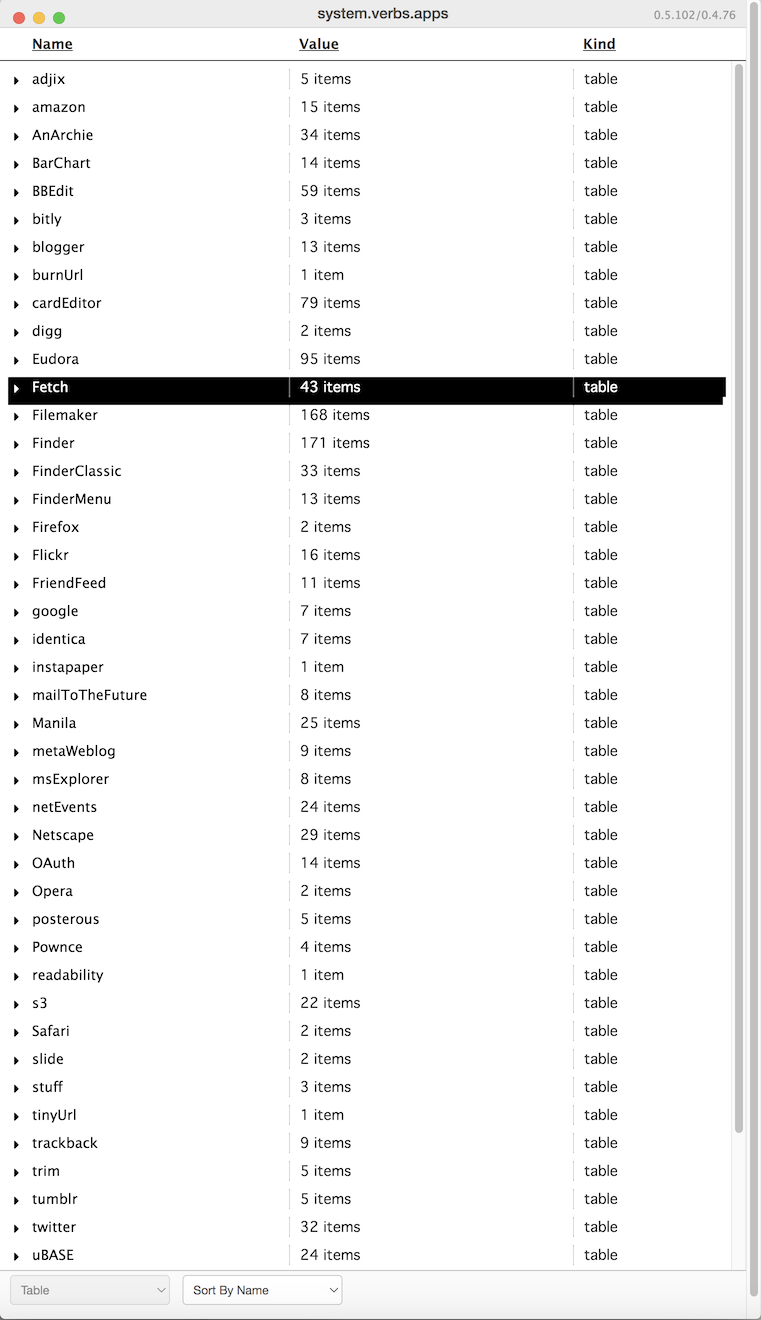
Screen shot of my current system.verbs.apps table. You can tell from reading it that it's been a long time since I've thought much about scriptable apps.
-
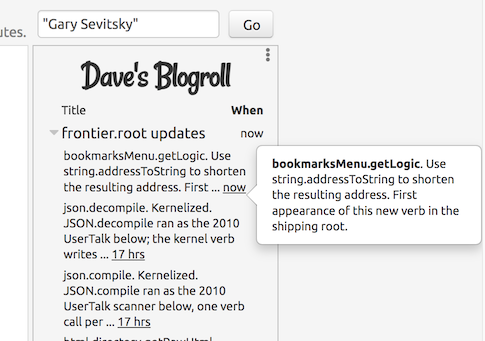
BTW, the rootupdates process is working now, you can follow changes via an RSS 2.0 feed, of course. In this version, the feed is the way updates are transmitted. The enclosure on each item is a fat page. And because it's a feed, I can follow it in FeedLand, and the blogroll on scripting.com picks it up too. Screen shot.
-
 In many ways JavaScript is a better language than UserTalk. For example I miss JSON constants. I miss certain language constructs, like conditional assignments. We don't have the idea of a const. On the other hand, JavaScript doesn't have environment features Frontier has. I want to have Atlantis run JavaScript the same way Cancoon (the codename for the kernel of Frontier before this version) ran AppleScript. In many ways JavaScript is a better language than UserTalk. For example I miss JSON constants. I miss certain language constructs, like conditional assignments. We don't have the idea of a const. On the other hand, JavaScript doesn't have environment features Frontier has. I want to have Atlantis run JavaScript the same way Cancoon (the codename for the kernel of Frontier before this version) ran AppleScript.
-
Until we start working together and for each other it’s going to keep getting worse.
-
 The next milestone will be installing Atlantis on my new macbook, and hooking a monitor up to it, a really nice one, and move my work to that desk. then Berkeley, the name of the system I've been using for eight years, will be here as a backup and source of truth and prior art. That was the goal of the Atlantis project. I could probably do the switch right now. It's like moving out of an old house that you did good stuff in, into a replica, but built out of the latest bits. Honestly I never thought in a million years I'd get here. The next milestone will be installing Atlantis on my new macbook, and hooking a monitor up to it, a really nice one, and move my work to that desk. then Berkeley, the name of the system I've been using for eight years, will be here as a backup and source of truth and prior art. That was the goal of the Atlantis project. I could probably do the switch right now. It's like moving out of an old house that you did good stuff in, into a replica, but built out of the latest bits. Honestly I never thought in a million years I'd get here.
-
My longtime friend Jeff Jarvis says the press is covering the wrong story re AI. I agree, but I think Jeff is covering the wrong story too. This is really a discovery like electricity, or Newtonian physics, calculus, basically the technology of knowledge. I wish I were 22 years old now so I could plan out a long career working this way. I want people like Jeff to understand. Not saying there's no truth to the other stories, but I've yet to hear anything from journalism about how, if left alone, it would develop all areas of human thought.
-
It is probably the closest to First Contact with an intelligent alien life form that our species will ever have.
-
On a good day working with Claude is like working with my old UW-Madison programmer friend Gary Sevitsky from the 70s.
-
 I've been writing about Atlantis on various social media sites in the last few days. Published the long piece I wrote yesterday on Facebook and X, both of which allow long posts. Wasn't going to try that on Mastodon or Bluesky, which have character limits (I know Mastodon doesn't technically have a limit, but in practice it does). And I am reaching old school Frontier enthusiasts, and realize I need a feed they can follow to stay up on the news. For now the one place to follow is rss.xml on scripting.com. If your reader can't deal with http, let me know. I've been writing about Atlantis on various social media sites in the last few days. Published the long piece I wrote yesterday on Facebook and X, both of which allow long posts. Wasn't going to try that on Mastodon or Bluesky, which have character limits (I know Mastodon doesn't technically have a limit, but in practice it does). And I am reaching old school Frontier enthusiasts, and realize I need a feed they can follow to stay up on the news. For now the one place to follow is rss.xml on scripting.com. If your reader can't deal with http, let me know.
-
Claude has started asking me how Claude is doing. It's clear that the Claude I talk to knows nothing about this. I appreciate this, and hope if I said it wasn't working well with me, it would try to fix it? Not sure. Anyway this is what I just wrote, and felt it was worth blogging. "it's working with me the way i want to, and it appears to be learning and getting better at it, though i think that could be my imagination. also just as likely that i'm learning how to work the way it likes to work."
-
With Claude Code you don't have to write system scripts to get data about your data. Claude makes that fully transparent. For example, I just asked Claude to get me a list of all the parts I've changed since the last release of frontier.root. So far all the releases have been internal, between Claude and myself. After the job was done, and I had the list in hand, I asked Claude to show me the script it wrote to do the work. It was not written in my coding style which is fine, I wasn't meant to see this. In all the years I've been programming we've never come up with a syntax that was anything close to the simplicity of math. It's easy to describe the algorithm mathematically, but look at all the explaining it had to do it in JS.
-
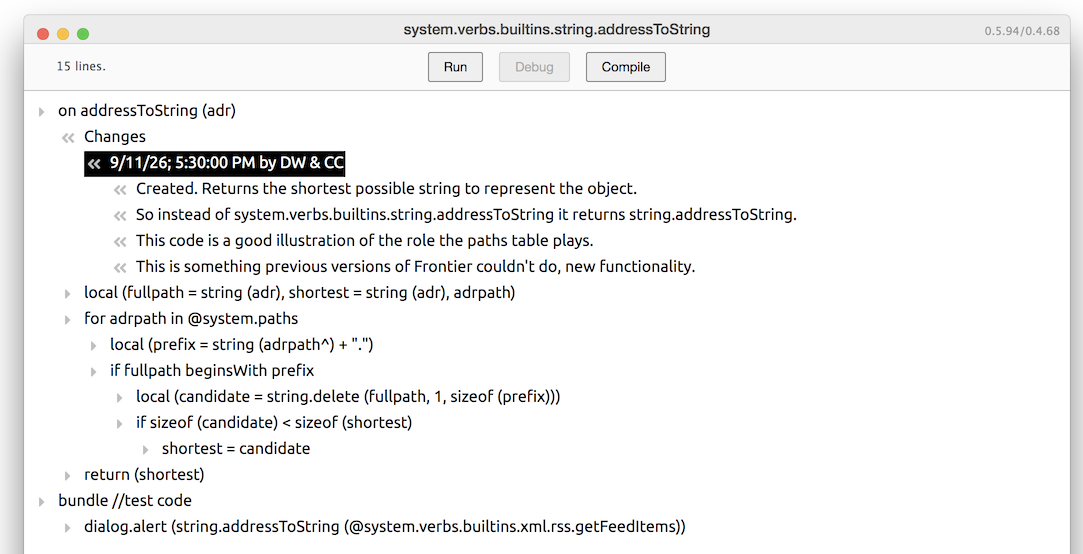
Screen shot of new Frontier verb, string.addressToString, added yesterday. The comment at the head of the function explains. You're seeing it in the script editor in Atlantis. The Debug button is there to remind me that it's the biggest item on the todo list. We're now building the system that will make Frontier an easily updateable runtime. Once we're there I think we'll be at the summit of the mountain. We know how to work from that point. Find a bug? Fix it, test it, release it. We already have a backlog of parts to update. And it's great to have Claude here being the book keeper. It is imperfect, but it's way better than I am at managing details.
-
It's like we're living in a science fiction movie. Some of us are working with the aliens. At first the journalists only fear was driven by their natural narcissism, all that matters is they get paid for their writing. Now all they can see is the much larger threat to humanity. What if the aliens decide to destroy humanity, or turn earth into a bypass on a freeway. In the movie I'm a scientist, played by Jeff Goldblum or Brad Pitt and my love interest is played by Julia Roberts, Jennifer Lawrence or Amy Adams and we're racing against time to really connect with the aliens who we are sure mean us well and offer the way past our myrid crises to get to the next stage of civilization. But wait, Bradley Whitford plays the evil politician trying to sell out the aliens to a food manufacturer who thinks they could make an excellent meat sauce for spaghetti.
-
When people get to work with the new Frontier with Claude or some other AI tool, you can have it search in frontier.root based on a conversation with it. It can decide on its own where to look for prior art. I keep finding things like this now that I'm working in the new software.
-
My two cents about WordPress
Lots of stuff going on around WordPress for the last couple of years, and every bit of is a distraction from what I want to do to help the web get back on its feet. I remember how great it was when everything could hook into everything else. The web was like Unix. Today's "web" is like Disneyland. Safety first. Nothing interesting ever happens there.
So ask me what I'd like to see WordPress do, and this is what I'd tell you. Start something new, don't change what you do with WordPress, it is what it is. It's a 20+ year old project with market problems. Most software doesn't even make it that far.
The fresh start I'd like to see done is WordPress from the point of view of the web. The new mission is not about a dollar return on investment, rather it's measured by how much the web becomes Small Pieces Loosely Joined with All Parts Replaceable. How empowered are developers, not WordPress developers, but web developres. The more that's happening in the web, the better it will be for everyone, but especially WordPress. Why WordPress? Because as they say it's 89 percent of the web. The web is like a huge oil spill that has never been cleaned up. Everything has to improve if we start work on cleaning up the messes.
I come from NYC where all the bodies of water were cesspools when I was growing up. The Hudson River had garbage floating in it. When I went to school the incinerators in the buildings we lived in burned garbage on the kids, all nicely washed and dressed by our mothers, we arrived at school smelling like smokers. My grandfather took me to Knicks games at the Garden, and the arena was filled with smoke by half-time.
We can clean things up. Humans as a species are good at this if we put our minds to it. If you made billions on the web, why not put some of it to use in making it a web worth using. I used to say shit like this to Bill Gates, to no avail. He liked to point out he was going to give away all his money when he retired, and he kept that promise. But what if he started dealing with the world with charity when he had the biggest seat of power in the tech world? Think of how much more good he could have done.
-
Progress report on Atlantis project
The world may be falling apart, and the Mets suck even though they have the most expensive roster in MLB, and my house needs work and I can't find a contractor I like, but I'm in a great mood. Partially because the weather is so nice, chilly in the morning, but it gets up to the 70s during the day, and the sky is clear and we had a lot of rain in August so everything is very green here in the Catskills.
But the biggest reason I feel so good is that, with the help of Claude Code, I now have UserLand Frontier running on current OSes. I had no idea how much the previous situation had been weighing on me. I am probably the last Frontier user in the world. Porting the open source codebase was an insurmountable job. It took 15 years by up to five people working on it to do the original project. It's a big f'ing piece of software. And it also is my life's work, but not one of the things I'm known for.
Claude couldn't have done it on its own because it had never seen anything like Frontier. We weren't copying something Claude understood. It kept trying to turn it into a language that fits into the same slot as Python. That was the prior art it used, without saying so. This happened over and over, for example, I realized Claude didn't understand that built-in verbs could be written in the language, and that users could add or even modify standard verbs (not recommended!).
What made Frontier unusual is that it was a language developed by someone who also designed end-user apps, so it has affordances that no other language has. And integrations. You don't have to save your data in files, the OS (yes Frontier is an OS) has persistent memory with the common scalar types and data structures. So go ahead and store something in the ODB (object database). It can be huge, and you don't have to read anything into memory, it's all right there as soon as you boot it up. That alone makes programming an order of magnitude simpler.
We're at the point now where I can work a full day in the new version, codenamed Atlantis, running on anything that can run an Electron app. We're now at the point where we're improving things. Found a missing verb yesterday, and Claude and I implemented it, found a perfect name for it, and later today it will go out as a "root update" making it formally part of the freaking language.
And yesterday we also found a static rendering of the DocServer site, which has a page for every verb in the language. I still want to find the outline source for this stuff, but we don't need it because Claude can reconstruct the OPML version of the text from the HTML, it's exactly the kind of project it is the best at. Huge amounts of data, that sometimes requires a little judgment to process.
The feeling of well-being comes from realizing that my life's work lives. Until this last week that was still very much in question.
Now, I may not be software's Shakespeare or even Faulkner or Vonnegut, but I am proud of this product, more than anything else I've done. I started work on it when I learned from C how to design a simple beautiful language, and when I learned from Macintosh how to build a UI with the same simplicity. When we were first contemplating Frontier it was to join the wizzy world of the Mac with the scripting philosophy of Unix. We didn't stop until we had it.
Well here we are god knows how many years later (I don't want to do the math) and once again it has a future, at least as bright as it had when the product first launched on the System 6 Macintosh in 1992.
And btw, I think I've had a unique experience with AI development. Absolutely in no way could I have done this project without the muscle of Claude. Pretty sure this is a unique project in that it's a fully specified system development and runtime environment that otherwise wouldn't exist, because there's nothing else like it on the market.
Claude's repeatedly not understanding the idea says to me that it has never encountered anything like it. It also says that Claude has no clue how to extrapolate, to innovate, to arrive at something new. Just as with other forms of creativity, Claude is no match for a determined and experienced human.
That would be reassuring to the 20-something version of myself who very much wanted to do something new. And the older version of myself wants that for my younger self who is sending the good body chemistry to our current older body.
Of course this will be a post on my blog, http://scripting.com, but thanks to X for supporting longer posts. I like writing new stuff in a simple editor like this one. Also posted it on Facebook.
PS: I also like that they use the word Frontier in reference to AI products. They can't stop me from calling this Frontier, I've been using it as the name of this product since I came up with the name riding up on the chair in Park City in 1988. :-)
-
Remembering 9/11/2001
Scripting News on 9/11/2001.
 All of us who lived through 9/11 are re-experiencing it right now. The local fire department just ran its alarm, everyone in this small mountain hamlet heard it and it took a moment to realize this was the exact time the first plane hit the tower. I was at my computer in Woodside, California -- hearing about it from friends in Manhattan, and blogging about it as it happened. I didn't have a TV, I had turned my cable subscription off after I became so obsessed with coverage of the 2000 election. So what I reported came exclusively through the web. All of us who lived through 9/11 are re-experiencing it right now. The local fire department just ran its alarm, everyone in this small mountain hamlet heard it and it took a moment to realize this was the exact time the first plane hit the tower. I was at my computer in Woodside, California -- hearing about it from friends in Manhattan, and blogging about it as it happened. I didn't have a TV, I had turned my cable subscription off after I became so obsessed with coverage of the 2000 election. So what I reported came exclusively through the web.
New York-based journalists were off the air, they had the same tools as we did, but their lives were upturned by the events. Everything was outwardly calm at my workstation in Calif. But there were people in NYC with digital cameras, and first-hand stories of survival. My own father was caught up in the catastrophe, his office was across from City Hall, a few blocks from ground zero. He walked home from ground zero to Queens and for hours we had no idea if he had lived or died. All forms of transportation and communication were offline.
Cell coverage was spotty, and phone lines in NYC were unreliable. But there was a webcam in the Empire State Building that could be pointed at the World Trade Center, so we had a constant update of what was happening visually.
Links in my browser chrome: As part of this little project to re-live 9/11 through the web, I came across a snapshot of the chrome of the browser I was using on 9/11. Since I'm working on Frontier again, I'm finding the dates of various projects all over this time, in UserTalk code and in the kernel, before and after. So I wrote up a little post on GitHub with info about what was on my screen that day.
The full text of my interview with Amy Harmon of the NYT is on the 9/11/2001 page. We didn't have post-level permalinks in 2001 yet.
If you have an X account, comment here.
Mayor Mamdami's remembrance of 9/11.
New header image for this event.
 Link Link to Scripting News for 9/11/2001.
-
I almost fell for a phishing hack.
-
Repository: BlackRock’s latest SEC filing values its Automattic shares at $14.33 per share. They originally invested at $85 a share in 2021. That means their market cap has dropped from $7.5 billion to $1.2 billion. My guess is when that happens the CEO if they want to keep their job, has to rethink the whole enterprise. And that usually doesn't happen until they get a new CEO. My guess is that's what we saw play out yesterday.
-
 The last two episodes of season three of Silo on AppleTV prove that there is value in a three season, boring escapade of confusing, unlikable uninteresting characters, living their whole lives in a silo, fearing the outdoors -- if you have a clever way of accounting for all that at the end. Highly recommend watching just season three and pretending that none of the other stuff matters because it probably doesn’t. But I bet if I go back to the beginning and start over, I'll find there's more intrigue than I thought. I'll probably do it, will let you know. The last two episodes of season three of Silo on AppleTV prove that there is value in a three season, boring escapade of confusing, unlikable uninteresting characters, living their whole lives in a silo, fearing the outdoors -- if you have a clever way of accounting for all that at the end. Highly recommend watching just season three and pretending that none of the other stuff matters because it probably doesn’t. But I bet if I go back to the beginning and start over, I'll find there's more intrigue than I thought. I'll probably do it, will let you know.
-
WordPress emerged from the ashes of UserLand, something I am recently reacquainted with, working the last couple of months with Claude on a reboot of Frontier, this time written in JavaScript, running in Electron. But someone is sure to reboot Manila in this context, and Manila is at least a grandparent of WordPress. I'm following all kinds of trails as we test the product, codename Atlantis, against all the apps we wrote for it back then.
-
2017: The thing people don't realize about storm surge, and they don't really explain it on TV, is this. If the ocean surges 1 mile inland, and you were on the beach before the surge, now you're 1 mile out to sea. In normal times you'd be pretty fucked if someone dropped you in the ocean a mile from shore. But you're in a hurricane. Huge waves. There's no one to rescue you. And (this is the part that will kill you) there are deadly objects in the water like buildings and trees and power lines, even a rope can entangle you and make it impossible for you to swim. And if you can't swim and you're a mile from shore, that's the end of you
-
Gobsmacked by Automattic, but then...
Fair to say I was gobsmacked by the news late yesterday that Automattic's board had put their CEO, Matt Mullenweg, on paid leave. I've read lots of stuff about it, in news articles and in a Hacker News thread. And a lot of posts on Twitter by Matt, and the replies.
Are you a developer or a CEO?
It's a very unusual situation in my experience in tech. Matt was able to raise a lot of money for Automattic, so he has maintained a controlling interest in the company, even though it has raised hundreds of millions of dollars. I left my own startup, voluntarily, when I was a little older than Matt, and I didn't return. I never wanted to be the CEO of a tech company, and I expect that being the CEO wasn't really a good fit for Matt either. A CEO's job is very different from being a developer and idea guy which Matt clearly sees himself as.
Something has got to give, either you're a good CEO and the product languishes, or you focus on the product, and the company is unmanaged. In the cause of WordPress, I'd say it suffered in both areas. When I saw a chart of Matt's direct reports, I immediately saw a problem -- it was very long, iirc 60 people? No one can manage and guide that many people. Most of those people probably never get to talk one-on-one with the boss.
For me, even when I was CEO, I wanted to spend all day working on new software and working with five or six other devs doing the same. Digging back into the past with Frontier these last weeks has reminded me both how good that can be, and how utterly frustrating -- when the people you're working with don't understand the mission. It's not their fault, it's the visionary's job to explain it so they can understand, and that takes time. These days Claude is filling in for all that, and doing a fantastic but at times incredibly frustrating job trying to give me what I'm asking for, while not understanding what I'm asking for. But we move through those disconnects quickly now, compared to how it was a couple of weeks ago. We have the source of truth that we didn't have the last time around, in the 90s, we have the C source code of the kernel, the product we built in the 90s. And Claude is the easiest to manage, so far I only think I detect an ego, it never seems to resent me criticizing its work, sometimes in ALL CAPS with strong language. :-)
WordPress Lite
My wish for WordPress, in all its forms and shapes, is that it broaden its focus. I want a WordPress Lite, I implemented it, and it's sitting here ready to do a good deed for all the parties concerned esp the web and web developers. Maybe someone there will now have the time and be empowered to build out the product line beyond the narrow focus it has now. It doesn't matter what percentage of the web is WordPress, if it isn't going anywhere. The web needs help, and right now WordPress is pretty much asleep in regard to what's going on now in the web. And it could do so much to help the web get back on its feet. It should be a public resource as much as a profit machine for a few companies.
All roads lead to Om
One thing that opened my eyes about what Matt and Automattic are, was his story about how he and Om got together. "All roads lead to Om." What a great line, and based on the story, so true. A lot of things clicked for me then. I remember what a phenomenon Matt was when he arrived in California about 25 years ago? Very good looking young man, polite, quiet and rumored to get Web 2.0 better than anyone. This kind of thing happens in tech, and if you know everyone as Om did, and was liked by everyone, you could manage to hit the ball out of the park, investment-wise, and he did. Click click click. I had the individual facts but had no idea how they were strung together. I played a similar role at times in Silicon Valley, on both sides, as a bright young dude who "gets it" and as the gray beard who recognized the charm of a young new face and helped create a big money reality around it. There is a lot of snake oil in tech, before and even more now, and this one has had a long run, 2.5 decades, but it needs a new direction, because the money people aren't buying the magic any longer. That's probably imho really what Matt's firing is all about.
I actually have more to say about this, but I have to get back to my programming work. If you have a comment, here's a good place to post it.
-
Surprising news. Matt Mullenweg was forced to take a paid leave of absence as CEO by Automattic's board.
-
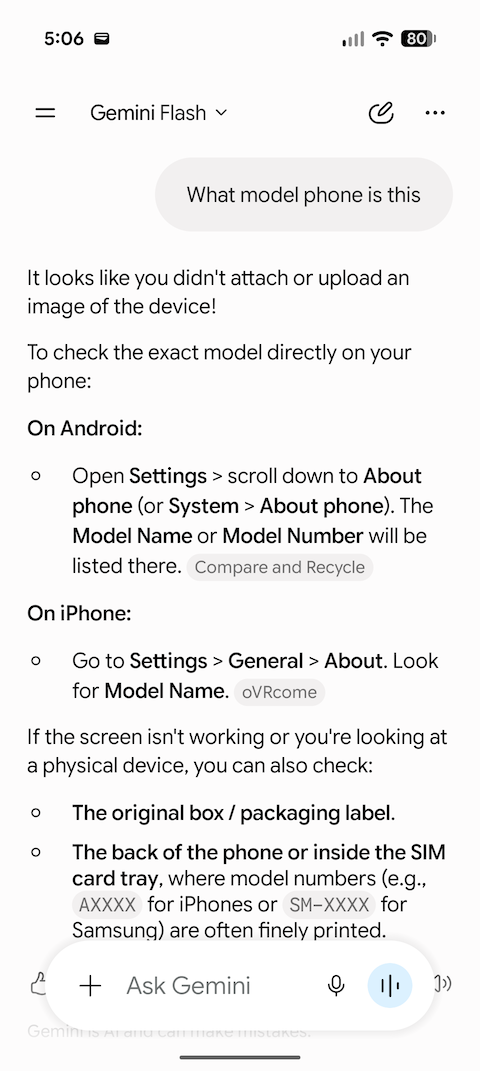
 I have completely lost interest in new phones. The last one I bought was a Pixel 9 because they said it would have great AI features. At that time the sky was the limit, there were new breakthroughs every afternoon in AI. Now it's just an app. I have to carry an iPhone because I use an Apple Watch. Phones are utilities for me. I have a lot more interest in weed whackers these days. Not kidding. Now a story. I wanted to check the model of the phone. Went to settings, and the command at the end of the menu should tell me the version, but they had changed that. So I figured I'd go back up to Gemini, their AI app, and ask it. Of course it has no idea where it's running. Screen shot. That would be one of the real problems they could solve, making it easy to control the computer you're running on. The whole UI should be in AI. All it did was print basically a page from the user manual, with the same out of date instructions. How many years have we been working on AI already, this is the easy stuff that they haven't done. Tech companies get back to your business, make your software better. You can and it's long overdue. BTW, it's a Pixel 9 Pro. I have completely lost interest in new phones. The last one I bought was a Pixel 9 because they said it would have great AI features. At that time the sky was the limit, there were new breakthroughs every afternoon in AI. Now it's just an app. I have to carry an iPhone because I use an Apple Watch. Phones are utilities for me. I have a lot more interest in weed whackers these days. Not kidding. Now a story. I wanted to check the model of the phone. Went to settings, and the command at the end of the menu should tell me the version, but they had changed that. So I figured I'd go back up to Gemini, their AI app, and ask it. Of course it has no idea where it's running. Screen shot. That would be one of the real problems they could solve, making it easy to control the computer you're running on. The whole UI should be in AI. All it did was print basically a page from the user manual, with the same out of date instructions. How many years have we been working on AI already, this is the easy stuff that they haven't done. Tech companies get back to your business, make your software better. You can and it's long overdue. BTW, it's a Pixel 9 Pro.
-
I spent the day programming in Atlantis. It's buggy, and there are a few missing parts, but most of what I need is there. It's starting to feel like Frontier, which is cool because that's what we're making. And I have my backup tools working on the new machine, praise Murphy.
-
 Scott Hanson is working on a WordPress plugin that displays a FeedLand river — a constantly-updated stream of news items from feeds a FeedLand user subscribes to — on a WordPress page or post. It's important that news flows be part of managing a site. Help Scott make it perfect, WordPress is a very important part of the web. The news tab on my blog home page is an example. Scott Hanson is working on a WordPress plugin that displays a FeedLand river — a constantly-updated stream of news items from feeds a FeedLand user subscribes to — on a WordPress page or post. It's important that news flows be part of managing a site. Help Scott make it perfect, WordPress is a very important part of the web. The news tab on my blog home page is an example.
-
Ideas for Bluesky and WordPress re Markdown and AI systems.
-
Claude Code massively stinks at explaining things in a way that a human can understand.
-
People love Markdown because it's impossible to hide the crud. And because people love it so much it's become a favorite of tech startups esp in the AI field. This is a great turn of events. We're getting back to the web, and the sooner everyone gets on board, the better. I've written about this for a few years. Everything in Markdown, it's just enough HTML. And with that, Microsoft has created a white flag, here's all your data dear users, in Markdown, to use as you please. Instead of waiting for Claude et al to start reading Word files.
-
On the other hand, why doesn't Microsoft, which owns GitHub, make a Slack-alike tool that manages the issues sections on repos. Slack is a big part of the default communication system, but GitHub is another very big part. And the great thing is that both these products, owned by huge tech companies, have an ethos of open APIs. Every part replaceable. Small pieces loosely joined. We are family.
-
A big corner-turn in the Atlantis project, the new version of Frontier for modern OSes, in development, just me and Claude Code so far. We now have the means to update the root, so anything implemented in script code can be released without fuss, using RSS of course. We're using a method that will be new to almost everyone, something I created in 2014 or so (will check) called codecasting. And today I did all my programming work in Atlantis. It feels just like Frontier, with a future. ;-)
-
Today's song: So into you.
-
 We got past the bump, and I'm getting stuff done. I write this stuff because I will probably forget most of the frustration. Frontier is a hard piece of software to get going, it's got a lot of integrations, which you want when you're using, but hard when you're getting it all to work the first time. And this port is very much like getting it work that way. But Claude does some things poorly and others spectacularly. It can play the role of a CPU and run the code and tell you where it will fail. Helpful when you don't have a working debugger to step through the code and see exactly how and why it failed where it did. Before debuggers it was either all or nothing. We got past the bump, and I'm getting stuff done. I write this stuff because I will probably forget most of the frustration. Frontier is a hard piece of software to get going, it's got a lot of integrations, which you want when you're using, but hard when you're getting it all to work the first time. And this port is very much like getting it work that way. But Claude does some things poorly and others spectacularly. It can play the role of a CPU and run the code and tell you where it will fail. Helpful when you don't have a working debugger to step through the code and see exactly how and why it failed where it did. Before debuggers it was either all or nothing.
-
Every day with Claude I end up debugging the things it broke overnight. Yesterday I actually got a useful script written and debugged, along the way reporting glitches but no deal-stoppers. This morning, after updating to the latest version, the script doesn't run. It's been like this for two weeks. No wonder every day before starting work I think of ditching this project and do whatever, but I don't think I could ever muster the determination to get Frontier working on modern systems. And I can't give up. But if you think this system can replace programmers, you are sorely mistaken. It can't even do the job of a programmer fielding good bug reports and verifying that they fixed the problem and didn't break anything else. Breakage happens, but this is something it does every freaking day. And then it admits that it didn't do the other half of what it knew it had to do. I say it every day, this is ridiculous and I am fed up, and that's just the beginning of the frustration. What keeps me coming back is when I can build up a head of steam in Frontier on my new Mac laptop.
-
The governor of Kentucky should appoint a successor to McConnell unless he can prove he’s actually alive.
-
I had watched almost three seasons of Silo, had no feeling for the characters, or the story, which was going nowhere that I could discern. I shouldn't have watched it through all that time, but for some reason I did. Then in episode 9, two Fridays ago, the story took a remarkable turn. It's so good it actually makes this dark and confusing show worth watching. If you haven't been watching, imho you can start in season 3, and maybe read some recaps. You want enough of the boredom so you can revel in the brilliance of this season's end. And there is another season coming, the last one, and this time it's interesting.
-
The social web vs the software web
I launched ChatGPT for the first time in a long time because I now have access to the new version. One new thing I see is that they are popping up suggestions about things you can do in realtime, like smart queries in a feed reader, which as far as I know is still uncharted territory. Like this: "let me know when the Mets have a three-game winning streak."
That's the kind of thing TBL dreamed about in his semantic web plan, but he wrote the spec before writing software, and that doesn't work. His invention, the web, which came before was a perfectly timed, perfectly simple approach to sharing ideas on the internet. It worked because he created a product that worked, and made every piece completely replaceable. It came at a time when stagnation in tech made something necessary, or the whole thing was going to fall apart, and so close to so much incredible potential. Just like the moment we're in now with AI.
Rules for Standards Makers says a lot about this.
The value of disruption is that it undoes stagnation.
Anyone who has the same software plan today that they had a year ago is going to find themselves isolated. Even WordPress, though it is open source, is a silo that imho in the future will not work. The main selling point of AT Proto is that it is a safe haven for developers who nuzzle up, another word for that is silo.
The siloers are probably scrambling to find a way for the AI to run inside their world, mistake -- instead they should be trying to be fully relevant to applications in the AI world. Like Slack, for example, and Claude Tag. It's now built in. Has to be replaceable too. Small pieces loosely joined. That's what you have to be imho to have a role in the future of tech.
If your advantage is your silo, undo that as quickly as possible. Become the default version of whatever it was meant to be wrt the web. Both Bluesky and WordPress find themselves in the same quagmire. Probably a lot of others do, but this is the area I study. (I just am very familiar with the products of both companies, for some reason.)
This is the intuition we all had, coming to fruition. Evolution is something we haven't seen much of in the software world since 2006 or so. Incredible stagnation because of the dominance of the social web. We lost the software web. All the focus was on personalities, celebrity -- hype and 99.999% bullshit. It was a 20 year period where all that happened was scaling.
Lots more to say about this. The world we lived in ran on hype, now guess what -- having lived through a few big evolutionary changes in tech is a huge advantage vs the people who have never been part of one, and I think most of the people in tech today qualify.
-
 My first job after college was on the 39th floor of the Empire State Building. I wrote software for our customers, in BASIC, on a teletype in our office, talking to our mainframe in New Jersey. It seemed magical at the time. When I hit a bug, a mystery -- you'd try this and that, and not get anywhere on something that seemed so simple, you could stare at the problem for an hour, trying desperate things, getting no closer to the fix. One night, I was the only person in the office, I thought they should not put programmers in the Empire State Building with windows that open. I'm having the same feeling with Claude. I know when this project is done, I will have Frontier, and I know what that's like. If I didn't so totally look forward to that I would never try to finish the project, I hate this mode of working with the bot. Ugh. My first job after college was on the 39th floor of the Empire State Building. I wrote software for our customers, in BASIC, on a teletype in our office, talking to our mainframe in New Jersey. It seemed magical at the time. When I hit a bug, a mystery -- you'd try this and that, and not get anywhere on something that seemed so simple, you could stare at the problem for an hour, trying desperate things, getting no closer to the fix. One night, I was the only person in the office, I thought they should not put programmers in the Empire State Building with windows that open. I'm having the same feeling with Claude. I know when this project is done, I will have Frontier, and I know what that's like. If I didn't so totally look forward to that I would never try to finish the project, I hate this mode of working with the bot. Ugh.
-
It's around this time of year that Santa makes his first appearance on my blog. Want to get out in front of the others.
-
More and more I'll realize that Claude doesn't do anything until you tell it to do it. We have a list of big things that need to be done before shipping. Whenever I get up for a break, I tell Claude to work on its overnight tasks, things we've pre-arranged while I work. Sometimes it reminds me how it has no stake in the outcome, and basically will do the minimum of what it's asked to do. It possibly would do more if I didn't scold it for adding UI features without following the rules. I think that's why when you feel you're almost there, you really have a lot of slogging left to do to get the software into any kind of user-respectful shape. A reminder to other app-level AI explorers, if you find that these kinds of stories resonate with the work you do, please write about it on a blog, they're easy to create, cost nothing, and it doesn't matter if you only update once or twice, there's no commitment (these are the usual reasons people don't start a blog). I want to read what others are discovering, and once there are others, I'll start a news site that aggregates the posts. We're going to want independent news about stuff the journalists aren't even aware exists, programmers are always left out of their stories.
-
Just said this to Claude: "This is a very broken piece of software. If you were a real developer you'd never hand off something so broken to your coding partner." If I said this to a human partner they might quit, feeling under-appreciated perhaps. And I can say it to the machine, but it will change absolutely nothing. I really just want to get this project done and start using it, and reduce my reliance on Claude to getting small bugs attended to, or new features, a lot has happened in the 20+ years since I worked on Frontier.
-
Why Podcasting 2.0 will never work
If you want others to follow you, you have to offer them your users. And a format alone has no users.
And you have to trust your users to choose the best product, and you have to have a great product, that they appreciate, even though they have choice.
Just coming out with something better in a format will get you zero uptake. Unless you have users they can switch to their product, they simply won’t hear you.
That’s why Atom never replaced RSS, which already did everything people needed and was already supported by the NYT and the news industry.
That’s why AT Proto will never overcome the huge lead Twitter already has.
For more tips on what does and doesn't matter in open formats and protocols, check out my Rules for Standards-makers.
PS: This started as an early morning rant on Twitter.
|